Brand Strategy for Startups: A 2026 Blueprint

Most startups pour everything into the product. The pitch deck gets refined sixteen times. The engineering team ships on schedule. The launch goes live.

And then growth stalls. Not because the product is bad, but because no one knows what the brand actually stands for.

Here’s the truth. A great product with a weak brand will lose to a mediocre product with a strong brand. 

If you’re looking for strategic direction, this is your blueprint for building a brand that does more than look good: one that drives recognition, earns trust, commands premium pricing, and scales alongside your business in 2026.

TL;DR: How to Win With a Solid Brand Strategy for Your Startup

  • Brand strategy is the foundation for every other marketing decision, not a design task you complete at launch.
  • Startups that define their positioning early grow faster, attract better customers, and command higher prices.
  • Consistent brand presentation can increase revenue by 10–20%, and brands with consistent presentation are 3–4 times more likely to achieve strong brand visibility.
  • AI is reshaping how brands are built, but a human-centered strategy still has to lead.
  • The brands that win in 2026 treat it as a business asset rather than a creative exercise.

Why Brand Strategy Is a Business Decision, Not a Creative One

The business case for investing in brand strategy early is overwhelming. 

According to Interbrand’s Best Global Brands 2024 report, the world’s most valuable brands have collectively missed out on $3.5 trillion in value creation since 2000 — largely due to prioritizing short-term performance over long-term brand equity. 

Brand strategy is about winning the room before you say a word. It shapes how prospects perceive you, how investors evaluate you, and how customers decide to trust you. 

As AI continues to reshape how brand strategy is built and executed, the startups that enter that landscape with a clear, differentiated brand will have a decisive advantage over those still figuring out what they stand for.

The Core Components of a Startup Brand Strategy

A brand strategy is a system of connected decisions that work together to shape how your audience perceives, remembers, and chooses you. 

Each component builds on the last, and skipping any of them creates gaps that show up later in the worst possible places, like a sales conversation, a fundraising pitch, or the hiring process.

Brand Positioning

Brand positioning is the specific space you own in your customer’s mind relative to every other option they’re considering. 

For a startup, it’s the most important strategic decision you’ll make in your early stages because it informs everything from your pricing model to your hiring criteria to the language on your homepage. Get it wrong, and no amount of paid media will fix it.

Strong positioning answers three questions with clarity: who you serve, what you uniquely offer, and why that matters more than the alternatives. Finding it requires honesty about your competitive landscape, including where your competitors are weak and what your best customers actually value that no one else is delivering. 

That intersection is where your positioning lives, and it’s almost always more specific than most founders are comfortable with.

Brand Voice & Messaging

Your brand voice is how your positioning comes to life in language. Every email, every social post, every sales deck either reinforces your brand or erodes it. 

Over time, the brands people trust most are the ones that sound like themselves everywhere they show up.

A strong brand voice framework includes:

  • A defined tone
  • Core messaging pillars
  • A clear value proposition
  • Enforceable language rules
  • Audience-specific language

When your messaging is intentional and consistent, it compounds. 

Every touchpoint reinforces the last, and your brand becomes something people recognize and trust long before they’ve made a purchase decision.

Visual Identity

Visual identity is the full system — typography, color palette, photography style, iconography, spatial principles — that makes your brand recognizable across every format before a single word is read. 

It’s vital to keep in mind that a logo is the starting point, not the finish line. Startups that invest in a coherent visual system early avoid the expensive, disruptive rebrand that almost always follows when visual decisions are made ad hoc.

Visual consistency isn’t an aesthetic preference. It’s a trust signal that can give your brand a competitive advantage, compounding every time your audience encounters you.

Competitive Differentiation

Knowing who you are isn’t enough. You need to know how you’re meaningfully different from every credible alternative your audience is considering. 

This point is where many startups go soft. They describe what they do rather than articulating why they’re the only real choice for a specific type of customer, in a specific situation, with a specific outcome in mind.

The goal isn’t to appeal to the widest possible audience. It’s to be the obvious, inevitable choice for the right one. 

A practical competitive audit looks for three things: messaging patterns your competitors all share (which signal where no one is differentiating), underserved audience segments, and the specific language your best customers use to describe the problem you solve. 

That’s where your real white space lives, and it’s where you can punch far above your weight.

Building Brand Consistency Across Every Channel

A brand strategy that only exists in a document is not a strategy — it’s a starting point. 

Real brand equity is built through disciplined execution across every channel your audience encounters you: your website, your social presence, your pitch decks, your email sequences, your ad creative, and every touchpoint in between. 

All of it should feel like it came from the same place, because in the minds of your audience, it does.

Small Inconsistencies Cause Brand Communication to Break Down

The challenge for most startups is that brand consistency across channels breaks down quietly. 

A social team runs with one tone, a sales team writes emails in another, and the website reflects a positioning statement that’s six months out of date. Each gap is small on its own, but cumulatively, they break down the trust you worked so hard to build. 

And the data makes the cost of inconsistency clear. Companies that remain consistent average 10-20% more revenue than competitors, according to Marq.

How to Build Brand Credibility as a Startup

Credibility is the most valuable thing a startup brand can build — and the one thing that can’t be manufactured through clever copy or a big ad spend alone. It has to be earned, systematically, through the signals you put into the market over time. 

The good news is that for a startup willing to be intentional about it, credibility compounds faster than most founders expect.

Thought Leadership & Content

One of the fastest paths to credibility for a startup is demonstrating expertise publicly and consistently. 

That means publishing content that actually teaches something, takes a genuine point of view, and positions your leadership as a trusted voice in the space. The brands people reference and recommend are the ones that said something worth remembering.

Thought leadership compounds over time in a way that most paid media simply doesn’t. 

A startup that publishes bold, insightful content throughout year one has a measurable authority advantage over competitors who stayed quiet. 

That authority shows up in search rankings, in sales conversations, and in the way journalists, partners, and investors perceive the brand. It’s one of the few brand-building investments that appreciates rather than depreciates.

Social Proof & Trust Signals

Social proof is one of the most powerful yet underused brand-building tools for early-stage startups. 

The right trust signals don’t just make a brand look credible — they make it feel inevitable.

Here are some areas where you can leverage social proof to gain credibility:

  • Client testimonials and case studies
  • Media features and press mentions 
  • Awards and certifications
  • Strategic partnerships 
  • Data and results on product or service performance

The brands that build the most durable credibility build a system of them that reinforces the same message from multiple directions. 

Understanding the strategies behind long-term brand credibility is what separates brands that earn trust once from the ones that hold it permanently.

What a 2026 Brand Strategy Actually Looks Like

The fundamentals of brand strategies haven’t changed. Positioning, voice, visual identity, consistency, and credibility are what help you gain traction.

What’s genuinely different now is the environment around those fundamentals. AI-assisted content production has raised the volume of content in every market, making differentiation more valuable — not less. 

The rise of founder and executive personal brands means your company’s brand and your leadership team’s brand are increasingly inseparable. 

And buyers, whether B2C consumers or enterprise decision-makers, have developed a sharper instinct for brands that stand for something rather than those that are simply optimized to look like they do.

The mindset shift that matters most: brand strategy isn’t a launch deliverable. It’s a living system that evolves with your business, your market, and your audience. 

The startups that scale aren’t the ones that built the brand infrastructure first and let it carry the product into the market with momentum.

The Brands That Win Do It on Purpose

Startups that treat brand strategy as a foundational business priority build something their competitors can’t replicate with a bigger ad budget: real, lasting market presence. 

Every decision made with brand clarity compounds. Better positioning means shorter sales cycles. Consistent voice means stronger recall. And earned credibility means faster trust.

Together, they create a brand that doesn’t just grow — it scales.

If you’re ready to build a brand that drives measurable growth and positions your startup to win, we have the strategy and the execution to get you there. 

Let’s build something that lasts. Schedule a discovery session with us today! 

Frequently Asked Questions About Startup Brand Strategies

What’s the difference between a brand and a brand strategy?

A brand is the perception — the feeling, impression, and associations that exist in someone’s mind when they encounter your business. A brand strategy is the intentional system you build to shape that perception over time.

When should a startup invest in brand strategy?

Earlier than most think. Every customer interaction and piece of content you produce before launch is already shaping how the market perceives you. Getting the strategy right from the start is significantly less expensive than retrofitting it onto a company that’s already grown.

How long does it take to build a recognizable brand?

Meaningful brand recognition typically begins to compound around the 12–18-month mark for startups that execute consistently, but the quality of that recognition is determined by the foundational decisions made in the first 90 days.

How do I know if my current brand strategy is working?

Look beyond engagement metrics. Unprompted brand recall, inbound lead quality, pricing power, and referral rate are the real indicators of a brand strategy that’s working.

What’s the biggest branding mistake startups make?

Building a visual identity before defining a positioning strategy — design without strategy yields a polished brand that doesn’t convert. It almost always leads to an expensive rebrand within the first year.
How to Start and Market Your CBD Brand

With the boom of the cannabis industry over the last couple of years, it’s no surprise that an easier go-to-market solution has emerged and is BOOMING. Cannabidiol (CBD) is the new craze and everyone wants in. Even if you already own a CBD brand, keep reading to learn how to start and market your CBD brand correctly.

Starting and marketing your CBD brand is not as easy of a task as it was two to three years ago. The market is extremely saturated and there are some extremely big players in the game now with unlimited funding. CBD is officially mainstream in the entrepreneur and investor world, which makes everyone want to join the bandwagon.

We’ve been waiting for our 80yr old grandparents to give us a call saying how they are launching a CBD brand. All jokes aside, it seems like everyone is wanting a piece of the pie. How big is the CBD pie?

What is CBD?

Before we dive into how big the CBD market is, we want those of you that don’t know what CBD is. 

CBD is short for Cannabidiol. CBD is one of over 100 known compounds found in the cannabis Sativa plant. This compound is found in both THC-rich strains of marijuana and also hemp. These plants are both classified as cannabis but the difference is that hemp produces only small amounts of THC, which are less than 0.3%. The compound carries much higher amounts as CBD, which is non-psychoactive eliminating the “high” feeling that THC has.

How Big is the CBD Industry?

Before we dive into how to start and market your CBD brand, you need to know how big the industry as a whole is. 

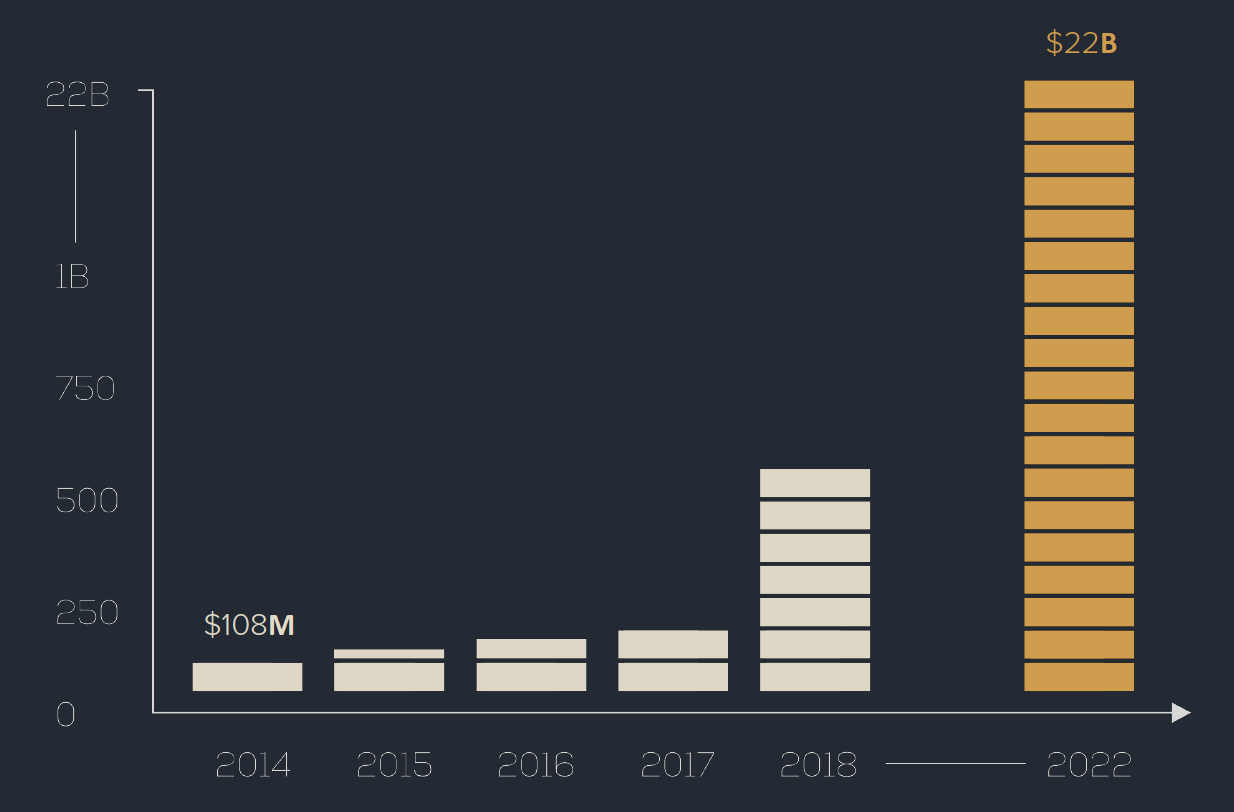
Brightfield states that the market for hemp-derived CBD products was around $591 million for 2018, and speculated to grow to $22-23 billion by 2022. Yes, that is a B for billion!

Below is a chart of the industry’s growth and future sales forecasting.

• 2014 – $108 million industry

• 2017 – $190 million industry

• 2018 – $591 million industry

• 2022 – $22 billion industry

CBD, CBD Growth, CBD Market, CBD Industry, Grow CBD Brand

Is CBD Legal?

Everyone wants to know, “Is CBD legal?” If you’re growing industrial hemp with the sole purpose of extracting high-quality CBD, that sole purpose is currently backed by the federal government. In December 2018, the 2018 farm bill was enacted. Among many of its other provisions, it removed hemp (not cannabis) from the list of prohibited substances. Hemp is now a legal agricultural commodity, and so are the products made from it. 

Some individual states have taken a much different stance on this and have chosen to ban CBD products which is key for anyone who has an eCommerce CBD store. You can always see which states CBD is legal.

CBD is still available to purchase and consume across the majority of the United States and in most places products still appear to be available, although some cities have banned the sale of food containing CBD. “CBD cannot be lawfully added to food or be labeled a dietary supplement,” was stated by the FDA with their public hearing on May 31st, 2019.

How much THC can your CBD have to be Legal?

Hemp and certain forms of CBD are federally legal, but you need to understand what aspects to look for when purchasing a CBD product. Many CBD brands that start decide to work with white-label CBD manufacturers because they don’t have the necessary capital to go to some of the larger manufacturing companies. Do your homework before deciding to work with a white-label manufacturer.

For CBD to be considered legal, the industrial hemp must contain .03% or less of THC. Any more and the plant is classified as marijuana and has many different laws that will drastically affect you and your customers.

There is still much confusion between CBD vs THC, which leaves a lot of questions for the general public. Federal agencies have started enforcing 0.3% or less THC policy much harder, which will keep the public much more well informed and safe.

Start Your CBD Brand

After reading the above information, you now realize how much work you have in front of you. At Avintiv, we are very data and research-driven. Everything we’ve done with building and scaling over 200 successful brands, starts with research and strategy.

This information will help new start-up CBD brands and CBD brands that have hit a plateau. We highly recommend building a brief business plan or investor pitch deck that you can use as a roadmap towards success. 


CBD Business Plan

Writing a business plan is a good idea even if you never plan on getting a loan from a bank or bringing on investors. You are able to use this business plan as a road map and allows you to benchmark your progress to see how on or off track you are. We won’t go over all aspects of a business plan today. We will point out the key factors to focus on.

Market Analysis – The market analysis will give you a break down of the CBD market, what segments there are, and what type of consumers your company will be marketing to.

Competitive Analysis – You must research and present a clear comparison of your business to your direct and indirect competitors. You need to know your strengths and weaknesses between your business and the competition.

Products and Services – What type of CBD products will your brand carry? Are you launching CBD oil, edibles, topicals, cosmetics or vapes? What will differentiate you from the competition?

Marketing Plan – Your marketing budget must clearly explain how you’re going to reach your ideal customers to hit your sales forecasts. You must clearly define how it’s going to be done and what your marketing budget is.

Sales Strategy – This portion of your business plan explains how you’re going to be selling your CBD. Are you only selling on your eCommerce website or do you have national CBD wholesalers or retail accounts?

Funding – From personal experience, Avintiv Media is currently growing many CBD brands, and the average monthly marketing budget is $10,000 – $20,000. You need to list out how you are going to fund your CBD brand. Whether that’s personal cash infusion by the owner or going for funding.

Sales Forecasts – You must create a realistic sales benchmark of what your business can do in sales over the next 3-5 years. Break the first year down to monthly sales goals and then do years 2-5 by year. This will help you determine if you’re on or off track from your goals.


Grow and Market Your CBD Brand

Growing your CBD brand in 2019-2020 is going to be much harder than it was years ago. The market is flooded with new CBD brands every single day, so what is going to set you apart from the competition? We’re going to go over how we’ve been able to grow our CBD clients.

Branding for Your CBD Brand 

Branding is and will be one of the most important aspects of your CBD brand. This part is often overlooked as many business owners want to rush to market. They care more about Instagram, influencer marketing, and getting sales. Don’t fall victim to this or you won’t stand a chance with how competitive the CBD market is right now.


Company Naming

A lot of business owners pick a company name that they like for some reason and it never becomes a massive company because the owner was thinking about themselves versus the customer. When picking a company name, ask yourself these questions:

  1. Can I build a $100 million brand with this type of name?
  2. Will customers know exactly what we do when they hear the name?
  3. Does this name clash or interfere with any other CBD brand? (hire a lawyer for this)
  4. Is this a name that our company can build a community or tribe of customers around?

Logo and Brand Styleguide

Developing a logo and brand style guide is much more in-depth as this but for this article’s purposes, we are going to go in order with how our creative team decides on branding direction for our CBD clients.

  1. What is this brand’s ideal target market (customers)?
  2. What type of color scheme is this market used to?
  3. What are other major brands these customers buy from?
  4. What does our brand want to look like? Create a storyboard of brands, colors, and styles your company represents.
  5. What does our brand not want to look like? Create a storyboard of brands, colors, and styles that your company doesn’t want to represent.
  6. Hire an agency or freelancer to help begin the logo sketch phase
  7. Have them finalize 3 variations of logos to choose from (black and white – no color)
  8. Choose the top logo direction
  9. The agency or freelancer will then take your market research and decide on the 3 top color schemes to go with
  10. They will then present your main logo in 3 different color options to go with
  11. Once that is completed, the agency or freelancer should create your brand style guide so everything you do moving forward matches your branding 100%

You can even see how our creative team did a full rebranding for Avintiv Media and what went into the process.

CBD Product Design & Packaging

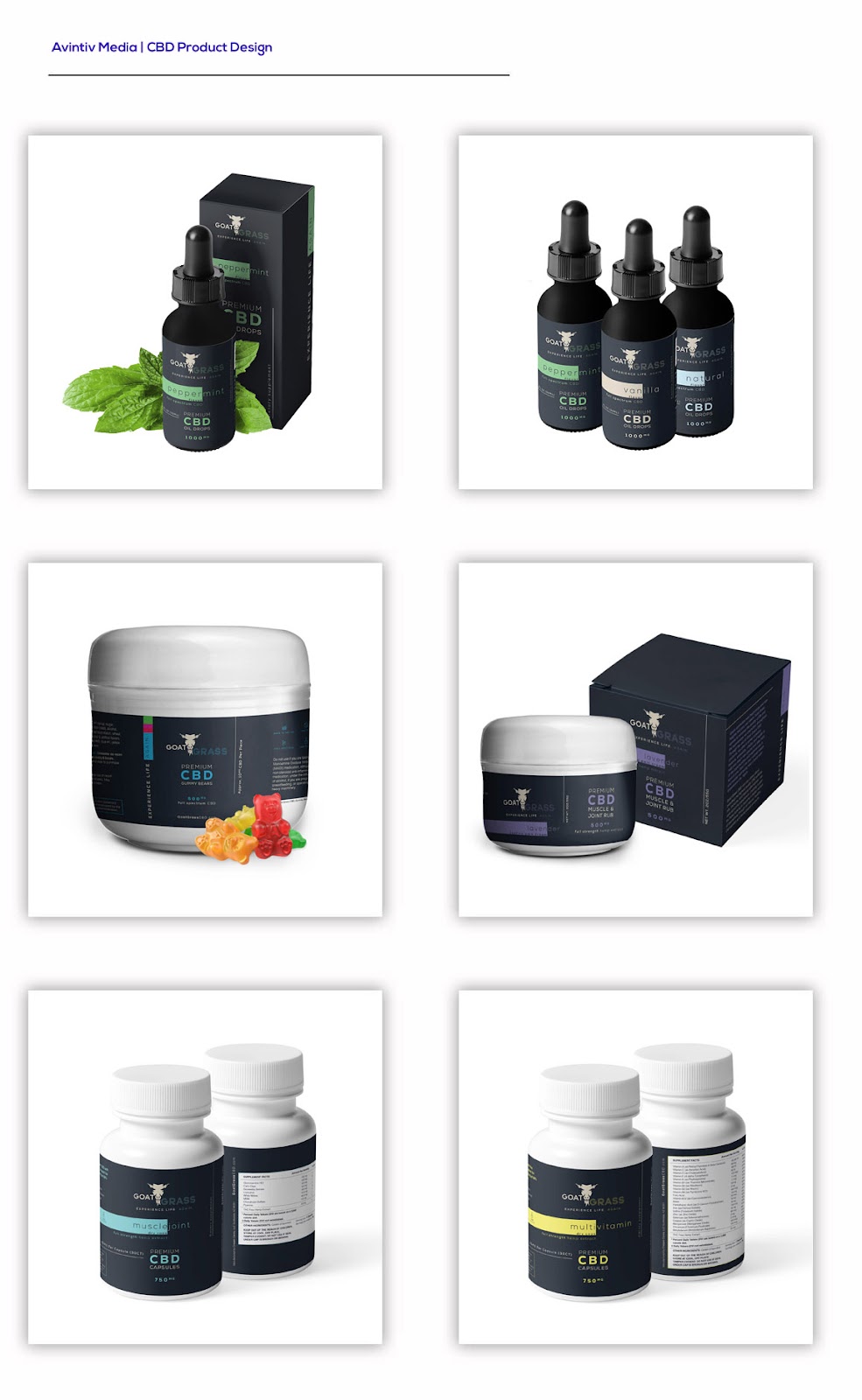
We won’t go into detail on how to develop your CBD product design or packaging as there are far too many steps to list in this article. Just know that this is by far one of the most important aspects of where your money should be going. If you want to win in the CBD game, it’s going to be the companies that products look better, feel better, and gives the customer a far greater experience.

Here are some examples of recent products we’ve designed in the CBD market.

CBD Branding, CBD Marketing, Goat Grass CBD, Product Design, Packaging, Branding, Avintiv Media

Marketing Your CBD Brand

SEO

Anyone who’s been in the Cannabis or CBD industry knows the trouble everyone has run into with properly being able to advertise or market their brand. Search Engine Optimization (SEO) is by far going to be one of the best investments you can make for your marketing plan.

You will want to have an agency that are experts at SEO as the CBD market is a completely different ball game when it comes to SEO versus many other industries.

Things you’ll want to add into your SEO campaign

Read more to find out How much should SEO cost?

Content

Just like SEO, content creation for the CBD industry is extremely important. For one, not everyone knows what CBD is just yet and people are wanting to learn more about CBD before investing in it.

Writing content around your ideal customers and your keywords that were chosen from your SEO strategy will help you choose what articles to write.

If you’re a CBD brand, you should be launching 2-4 blogs per week of at least 750 words. Below are things to make sure you do:

  1. Install Yoast SEO for WordPress
  2. Make sure your blog has an A+ readability score
  3. Add in your keywords throughout the blog
  4. Carefully choose what your Meta Title should be
  5. Carefully choose what your Meta Description should be
  6. Make sure your slug is done correctly 
  7. Make sure you internally link 2-4 times throughout your blog
  8. Make sure you link external sites 1-2 times throughout your blog

Social Media

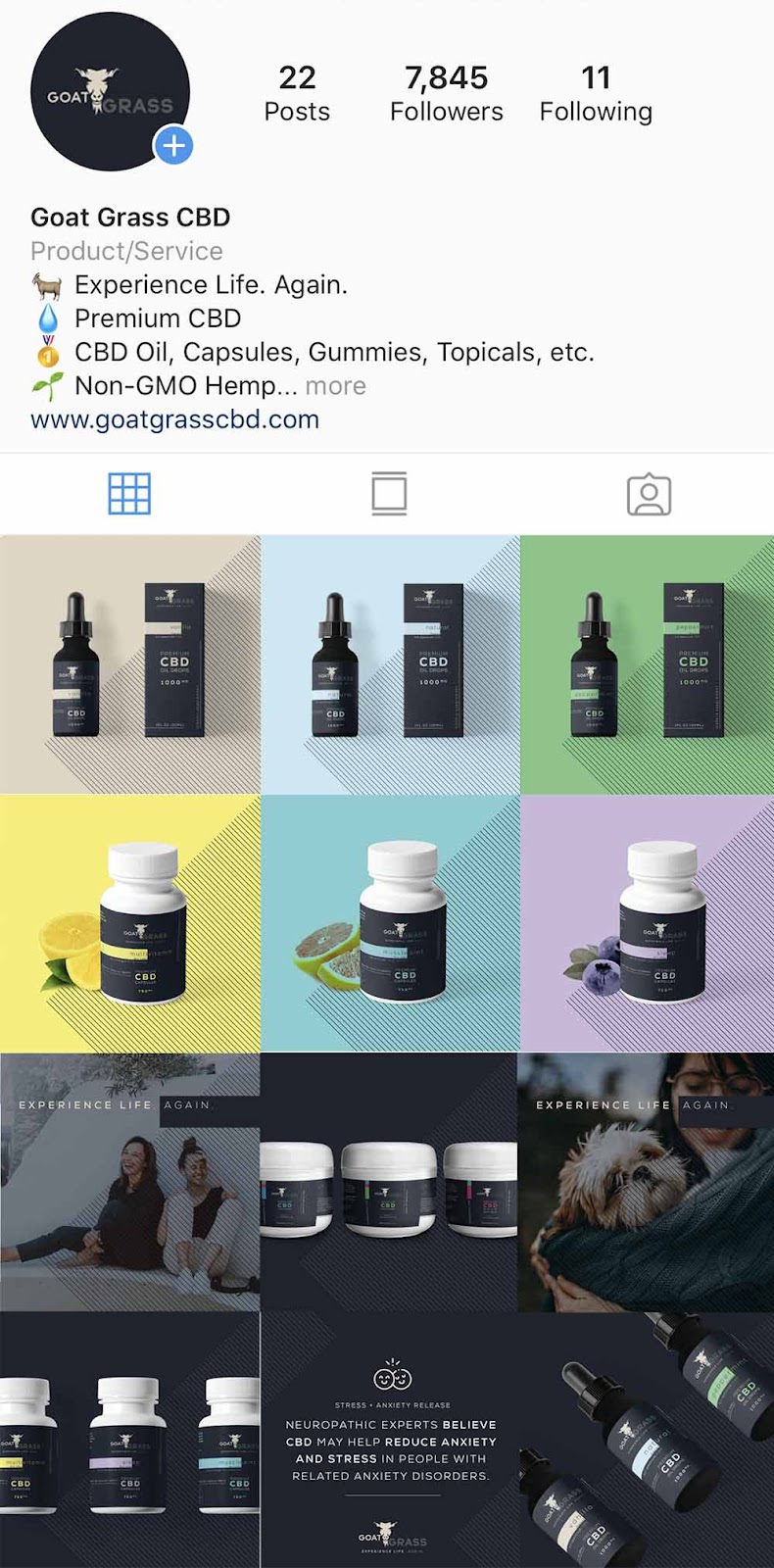
Social media has been the craze over the last 5-10 years but it has gotten extremely pricey to play on the advertising end of social media. For today’s purposes, we’re going to focus on posting organically on Instagram with 0 paid ads.

Tips for social media content:

  1. Thinking of your ideal customers, decide on what types of pictures or posts they will want to see
  2. Think of the verbiage or messaging your ideal customers will want to see
  3. Create a grid mockup over posts that all flow well with each other from an aesthetic standpoint (See below)
  4. Use a social media scheduler like Hootsuite to preschedule all of your future posts
  5. Make sure to engage with everyone that DM’s you or comments on your posts

Example of Instagram Grid that we did for our client, Goat Grass CBD.

Goat Grass CBD, Instagram Marketing, CBD Marketing, Instagram Grid, Instagram CBD, Avintiv Media

Advertising

As Facebook and Google start to loosen up with CBD advertising, there are still other ways to advertise your CBD brand.

A number of our CBD clients hire Avintiv to run retargeting ads for their online CBD stores. Below is just one of the options that’s available to advertise for the CBD industry.

Avintiv has access to a private display network that uses artificial intelligence to

aggressively optimize for click-through rate and conversion using a number of different

data signals that generate excellent results. On average our CTRs range from 1-3%

and up to as high as 8% (No this is not a typo). We offer this in the form of standard

display advertising, site retargeting or a blend depending on how much traffic the site

has.

We can run as many creatives as you like and can track conversions from the campaign as well.

This is helpful for tracking ROI.

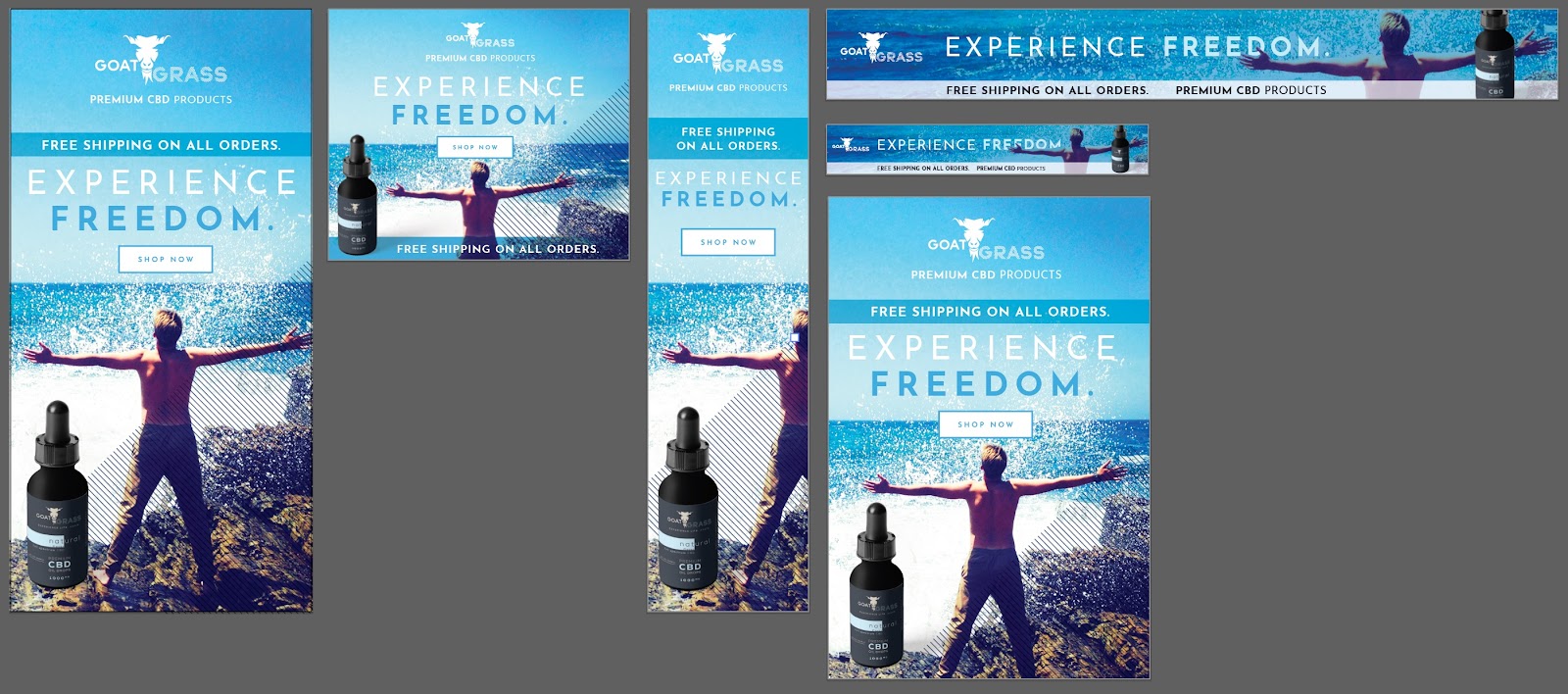
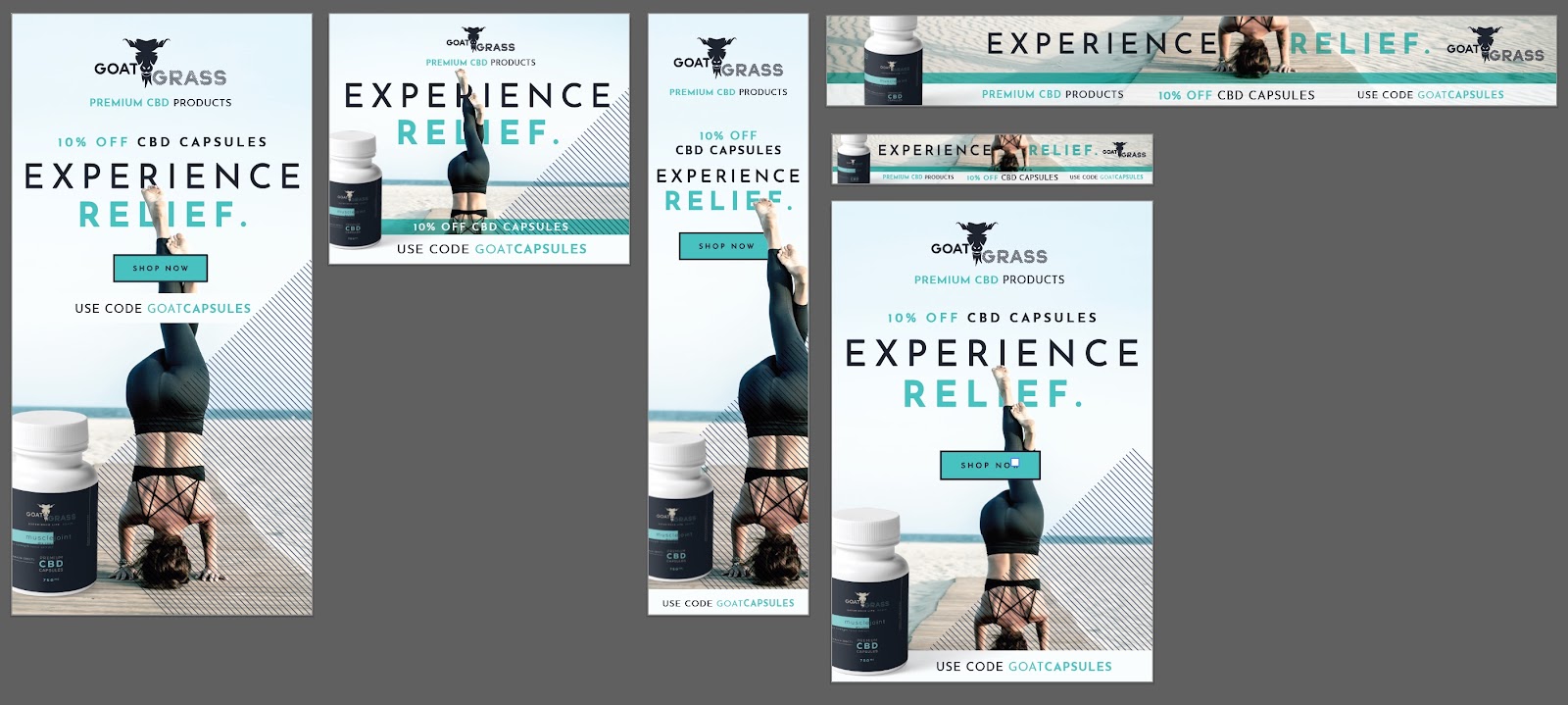
Below are some examples of display advertising creatives that we’ve created.

CBD Branding, CBD Marketing, Goat Grass CBD, Retargeting Ads, Branding, Advertising, CBD Avintiv Media

CBD Branding, CBD Marketing, Goat Grass CBD, Retargeting Ads, Branding, Advertising, CBD Avintiv Media

In Conclusion

As you’ve read through our article, we hope you’ve learned how to start and grow your CBD. As you can see, there is a lot of information that you need to know before launching and growing your CBD brand. The days of quickly getting to market and making a million dollars are long gone.

If you’re interested in seeing how Avintiv Media can assist you with growth, feel free to reach out to us on our contact page.